


JavaScript Menu by Deluxe-Menu.com
Home Contact Us Links Sitemap Search

donate
project news
shop or donate
play video

Twitter
HSI Australia on Twitter
Bookmark and Share
 
HSI
Is that dog you're wearing? quite possibly!

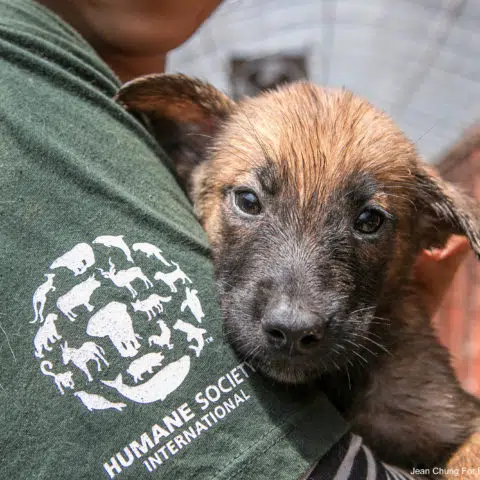
Humane Society International revealed, through laboratory testing, that a $299 Wittner branded fur vest advertised extensively throughout Australia is not ‘rabbit fur’ as labelled, but actually dog.

In 2004 following an 18 month undercover operation in China, HSI exposed the dirty trade of dog and cat fur into Australia. Our investigation revealed over 2 million dogs and cats were being slaughtered in the most horrific and inhumane ways possible. Our undercover footage of the ‘killing rooms’ mobilised Australians to support our campaign to ban the import of dog and cat fur.

The public response to our investigation was overwhelming, attracting the biggest outcry of all the animal causes HSI has ever championed, resulting in one of the largest petitions presented to the Australian parliament with over 70,000 Australians signing on. This campaign resulted in immediate action by the Australian Government, enacting a prohibition on all such imports.

Australia’s import ban followed the lead of other countries like the United States, Italy, Denmark, France and Sweden. More recently, the EU has joined the list of countries that want no part of this horrific trade. “Therefore, it was disappointing to find dog fur back in a major retail chain today,” said Verna Simpson, Director of Humane Society International. “This means that it has come through Customs undetected and this indicates there may be more product in the marketplace. We have today sent our findings to Customs to demonstrate that this product has started to reappear and ask them to increase their vigilance at border entry.”

HSI contacted Wittner as soon as the lab results came back and although they did not want to discuss it with us, they have removed the product from stores and, in fact, ceased to sell fur at all. We applaud Wittner for their swift action and Michael Wittner responded today saying “Our company has announced its decision to discontinue buying fur products.” He did want us to make the point that this was nothing to do with our findings.

With this product entering Australia again, the best policy for retailers is to follow Wittner's lead and steer clear of any fur. Mislabelling of fur out of China could mean that retailers are unwittingly buying in to a cycle of cruelty,” said Verna Simpson. “The brutality documented by our investigation team in the slaughtering of cats and dogs is alarming because of the sheer abusive violence involved. Such cruelty to any animal is totally unacceptable.”

The best policy for shoppers is to avoid buying any fur products, as without laboratory testing you could not tell if you are buying dog or cat fur and we are appealing to retailers to do the same.

The global investigation's findings include:

  • The death toll is conservatively estimated to be in the range of two million dogs and cats killed annually for their fur. Usually 10 to 12 dogs and 24 cats are killed to manufacture one coat - more if puppies or kittens are used.

  • The fur industry deliberately misleads consumers about product composition. A dog product may be sold as Gae-wolf, Sobaki, Racoon-dog and Asian jackal among many others. Cat products are often sold as Wildcat, Goyangi and Katzenfelle to name only a few.

  • Inhumane means are employed to kill animals for their fur. Investigators witnessed and recorded animals dying by slow suffocation, hanging, bludgeoning and clubbing, or bleeding to death. All of these methods involve severe panic, trauma, and needless prolonged suffering.

  • Labelling requirements are wholly inadequate allowing consumers to be misled. Unless tested, dog and cat fur is often indistinguishable from other animals used by the fur industry.

    Footage and images from the undercover operation available on request.


back to top