93% of Australians polled in a new YouGov national survey commissioned by Humane World for Animals Australia think that the Albanese Government should be delivering on its election promise to expand the nation’s list of species that cannot be imported as hunting trophies. At the May 2025 federal election, the...
A charismatic flagship rainforest species
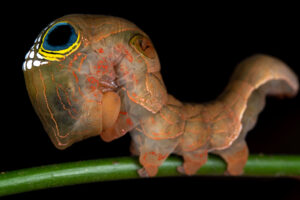
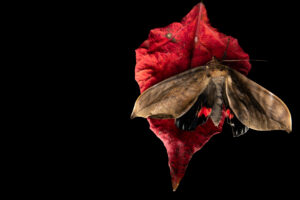
Left: Southern pink underwing moth larvae, Right: Southern pink underwing moth adult, © Isaac Wishart
Walking through the dimly lit subtropical rainforest, you stumble across an unusual caterpillar sitting on a vine. Sensing potential danger, the caterpillar tilts its head downwards, displaying its defence to dissuade you from eating it. These markings—two dark eyes and a skull-like set of teeth! You’ve found a mature larva of a southern pink underwing moth (Phyllodes imperialis smithersi).
After metamorphosing into an adult, southern pink underwing moths have a wingspan of 13–14 cm. While the moth’s forewings are shaped like dead leaves and appear dull, this contrasts with their striking, fuchsia patch on their hindwings that give them their name!
The southern pink underwing moth is found from northern New South Wales in Bellingen to Nambour in south-eastern Queensland. These moths favour shaded, low-light conditions and breed in the low understory. However, the species are quite particular in their needs with the host plant for caterpillars restricted to just one species—the native carronia vine (Carronia multisepalea) that the larvae feed on. Adult moths on the other hand feast on the juices of rotting or overripe rainforest fruits.
Threats
Threats to the species include actions which degrade and fragment subtropical habitats such as land clearing, logging, and farming. Exotic weed invasions also impact the species habitat quality, particularly when introduced vines outcompete the host plant or the understory is inundated by weed species.
Recovery actions
The southern pink underwing moth was classified as Endangered in 2002. In 2022, the southern pink underwing moth was listed as one of the 11 priority invertebrate species on the Threatened Species Action Plan 2022–2032 showcasing the federal government’s commitment to the species and recognition of their value.
Not-for profit organisations, Landcare groups, Traditional Owner groups and local councils are working with private landholders and on public land in New South Wales and Queensland to restore subtropical rainforest through weed control and establishing continuous, long-term rainforest habitat.
Considering the necessity of the carronia vine for the survival of the species, recovery actions also involve propagating the vine from collected fruit and returning grown plants to wild habitats and private properties to improve breeding sites for the moth. The southern pink underwing species has even been a recent subject of a children’s book, ‘Luca and the Moth’, leaning on education to promote the plight of this Endangered species. As a memorable and unique species, this moth has the potential to be a flagship species for invertebrates, garnering attention and action for broader invertebrate conservation.