We’re working around the globe to replace cruel, outdated animal experiments with innovative non-animal methods.
Taking suffering out of science
Animals don’t deserve to be used in experiments. Animal testing is a practice that belongs in the past. It’s time to prioritise animal testing alternatives that are safer, faster, and more reliable for humans—without causing animals to suffer.
The problem with animal testing
Millions of animals, including dogs, monkeys, rabbits, baboons, and mice,endure invasive and painful experiments every year. These procedures often occur without adequate pain relief and rarely predict how humans will respond to drugs or chemicals. Existing laws offer minimal protection for animals in laboratories.
Research in Australia
In Australia, the total numbers of animals used in research islargely unknownasthere are no requirements to report them. However, we do know that more than 1,450,000 animals were tested for science, research and teaching in Victoria in 2024, and more than 2,380,000 animals were used in New South Wales in the 2022 reporting year, including 188 primates.In fact, Australia is home to three government-funded primate breeding facilities that supply macaques, marmosets and baboonsfor experiments, and Australia has no ban on the importation of primatesfor research.
Lifelong suffering
Animals used for testing are typically confined to small, barren cages with no enrichment or companionship. Deprived of natural behaviors, they endure chronic stress, extreme physicalpainand loneliness. Young primates might be separated from their mothers, others might be tied to restraint devices for invasive procedures, exposed to substances, or put through major surgeries. Many procedures are repeated again and again. At the end of the experiments,most are killed or used in further research.
A better way forward
Cutting-edge, animal-free alternatives are changing the future of biomedical research and product safety testing. These innovative methods include: human cells, tissues and organ-on-a-chip technology, 3D bioprinting and robotics, and advanced computer modeling and artificial intelligence.
Non-animal research methods deliver faster, cheaper, and more accurate results than outdated animal experiments — protecting both human health and animal welfare.
Our global efforts to end animal testing
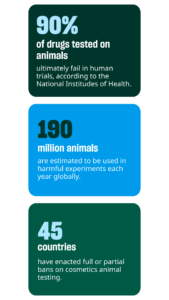
While 45 countries, including Australia, have full or partial bans on cosmetic animal testing, millions of animals continue to suffer in other types of research and testing. Humane World for Animals is leading efforts worldwide to promote humane research alternatives and eliminate animal testing.
Humane Society International Global launched a short film, introducing the loveable Ralph acting as a spokesbunny with one mission – to ban cosmetics animal testing around the world. “Save Ralph” stars Oscar winner Taika…
A review of New South Wales’ suite of animal welfare laws is currently underway, but the notable exclusion of the concept of animal sentience has animal welfare advocates concerned that NSW is lagging behind…
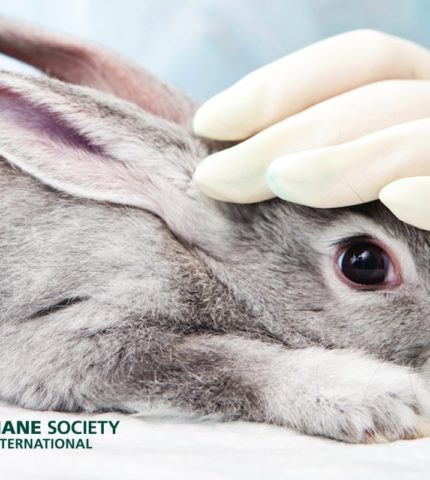
Animal testing for cosmetics is far from pretty. Rabbits, guinea pigs, mice and rats are used in labs and made to have cosmetic chemicals dripped in their eyes, spread on their shaved skin, or…