
June 2011

How many dead
Australian Sea Lions is too
many? Not 104 per year according to the Australian Fisheries Management
Authority (AFMA). Despite fisheries being closed for the deaths of far fewer
marine mammals, it appears that AFMA is willing to risk the future of
Australia’s only endemic sea lion so that a handful of boats can continue to
fish in denial of both the animal welfare costs and the science, which states
that the bycatch of threatened Australian Sea Lions must be reduced to as close
to zero as possible.
“The Government sanctioning of
the drowning of 104 Australian Sea Lions is a national shame,” said
Alexia Wellbelove of Humane Society International. “AFMA believes that
consumers will be happy for these amazing animals to be sacrificed so that a
small handful of fishers can continue to fish irresponsibly in the misguided
belief that more data will absolve them of the problem, no matter what the
welfare cost.”
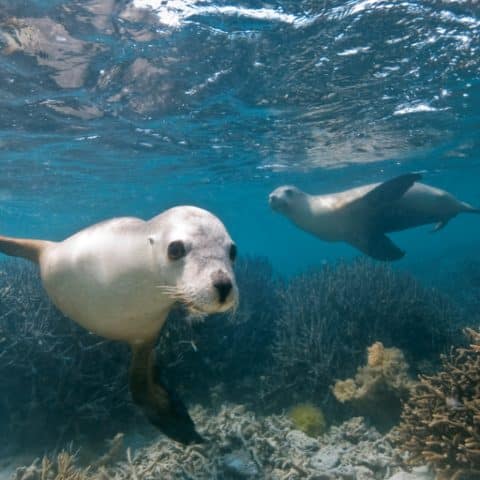
photo
by: Peter Shaughnessy, SA Museum In 2010, a
report1 was published outlining the impacts on Australian Sea Lions
from a South Australian fishery, which estimated that 256 were being killed each
year. The Australian Sea Lion is listed as a threatened species under federal
environmental legislation. Since then, HSI has been working closely with
Government and Fishery Management agencies in an effort to ensure that all
sub-populations of the Australian Sea Lion are not only protected, but allowed
to recover. This is important as for many sub-populations, the death of just one
Australian Sea Lion is too much for the species to withstand.
Following months
of analysis of the problem and successive unsuccessful strategies, the
Australian Fisheries Management Authority put in place revised management
procedures on a six-month temporary basis as of 1st May
20113. These management arrangements sanction the killing of 104
Australian Sea Lions, or 52 female sea lions a year before the fishery is
closed4.
“Whilst we welcome the small
steps taken by AFMA, such as the application of 100% observer coverage on the
fishery and larger closure areas, the fact remains that the preventable death of
104 animals a year from an already threatened species is totally
unacceptable,” said Ms Wellbelove.
“Fishers and fisheries
management agencies must stop using the excuse of the need to obtain more data,
and urgently put in place measures that ensure the reduction of Australian Sea
Lion bycatch, in line with scientific advice to as close to zero as possible.
Fishers are saying they don’t catch sea lions – if this is the case they have
nothing to lose by adopting management measures to ensure that this becomes a
reality, with the strong penalty of closure of the fishery if Australian Sea
Lions are killed. If this cannot be done, then the Environment Minister must
revoke the export approval for the fishery.”
Video
footage of Australian Sea Lions available on request
Notes - In April 2010, a report
revealed an estimated 374 Australian Sea Lions are killed each breeding season
(17.5 months), or 256 per year, in the Gillnet, Hook and Trap Sector of the
Southern and Eastern Scalefish and Shark Fishery. The report,
Mitigating Seal Interactions in the SRLF and the Gillnet Sector SESSF
in South Australia 2007/041 can be downloaded from http://www.frdc.com.au/research/recent-final
- As part of this fishery’s right
to export its products, the Federal Environment Minister gave fishery managers
and industry until 30 June 2010 to implement measures, including closures, to
enable the recovery of all Australian Sea Lion sub-populations.
- On 1st May 2011,
changes were made to fisheries management for the Gillnet, Hook and Trap (GHAT)
Sector of the Southern and Eastern Scalefish and Shark Fishery to afford better
protection to Australian Sea Lions and increase data available on interactions
in the fishery with other threatened, endangered and protected species. http://www.afma.gov.au/managing-our-fisheries/fisheries-a-to-z-index/southern-and-eastern-scalefish-and-shark-fishery/notices-and-announcements/changes-in-the-gillnet-hook-and-trap-sector-of-the-southern-and-eastern-scalefish-and-shark-fishery/
- The new bycatch triggers per
zone can be found at: http://www.afma.gov.au/wp-content/uploads/2011/04/ASL-zone-triggers-27-April.pdf
- The Gillnet, Hook and Trap
Sector of the Southern and Eastern Scalefish and Shark Fishery targets gummy
sharks, which are subsequently sold as flake in fish and chip shops.
|